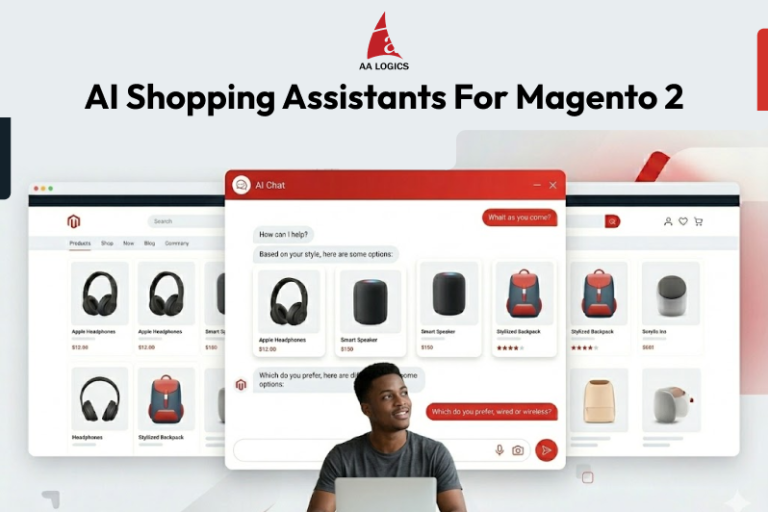
Introduction: The Way Shoppers Buy Has Changed — Has Your Store Kept Up?
Shoppers no longer want forty-three pages of sofas filtered by “colour: beige.” They want to type or say “show me a corner sofa that fits a small living room in a neutral tone, under £800” — and get exactly that.
This is happening now. Google’s AI Overviews, Perplexity, and ChatGPT shopping have taught consumers that natural language deserves natural language answers. When a Magento store still returns a keyword grid and a wall of filters, the mismatch is immediate — and expensive.
of online shoppers abandon a site because they cannot find the product they’re looking for. That’s not a traffic problem. It’s a product discovery problem — still solved, for most Magento merchants, by tools built for a pre-AI search paradigm.
This guide covers what Magento 2 store owners and ecommerce leaders need to know about AI shopping assistants: what they are, how they work, how they differ from conventional tools, and what to expect next.
What Is an AI Shopping Assistant?
An AI shopping assistant is a system embedded in an ecommerce store that understands natural language queries, interprets shopper intent, and responds with relevant products, recommendations, and guidance — replacing or augmenting keyword search.
Unlike a basic search bar or scripted FAQ chatbot, it processes what the shopper means, not just what they typed. It handles ambiguous queries, clarifying follow-ups, multi-turn context, and interaction patterns that surface better results.
How It Works
A modern AI shopping assistant is built on three layers:
Layer 1
Language Understanding (NLP / LLM)
An LLM (e.g. GPT-4.1 Mini) parses queries semantically — treating “waterproof for hiking” and “waterproof jacket for light summer hiking” as the same intent, not disconnected keywords.
Layer 2
Product Catalog Intelligence
Connected to Magento catalog, attributes, categories, and inventory via a vector database. Product data becomes embeddings so retrieval is based on meaning, not keyword overlap.
Layer 3
Conversational Interface
Text, voice, or image chat that keeps history and handles follow-ups like “show me the same but in blue.”
Core Technologies
- LLMsGPT-4 / GPT-4.1 Mini for language understanding and generation.
- Vector DatabasesPinecone, Weaviate, or Chroma for semantic catalog search.
- NLPIntent parsing and entity extraction (colour, size, price).
- RAGGrounds answers in real catalog data to prevent hallucinations.
- Multimodal AIText, image, and voice in one experience.
Semantic vs lexical: Traditional search matches words in the database. AI assistants understand that “quiet laptop for university” and “low-noise notebook for students” are the same intent — and handle follow-ups and multi-attribute queries keyword search can’t.
How AI Shopping Assistants Compare to Other Solutions on the Market
Most Magento merchants evaluate three options: SaaS search platforms, scripted chatbots, or Magento-native LLM extensions.
| Capability | SaaS Search & Discovery (Klevu / Athos Commerce, Algolia, Constructor) | Scripted Ecommerce Chatbots (e.g. MageDelight AI Assistant) | Native LLM-Powered Extensions (e.g. AALogics AI Chatbot Shopping Assistant) |
|---|---|---|---|
| Pricing model | SaaS, usage/revenue-based ($600–$1,850+/mo typical for mid-market) | One-time or subscription | One-time extension purchase |
| LLM-powered natural language understanding | Partial (NLP/vector matching, not full conversation) | No | Yes |
| Voice search | Rare | No | Available in some Magento-native extensions |
| Image / visual search | Enterprise tiers only | No | Available in some Magento-native extensions |
| Runs natively in Magento (no external SaaS dependency) | No — hosted externally | Yes | Yes |
| Admin-configurable prompts, persona, and model | No | Limited | Yes, in well-built implementations |
| Open-source / extendable codebase | No | No | Varies by vendor |
| Best fit | Large catalogs (10k+ SKUs), dev-resourced teams, budget for ongoing SaaS fees | Basic FAQ / order-status use cases only | Mid-market Magento merchants wanting conversational commerce without recurring SaaS lock-in |
Traditional search works for shoppers who already know what they want. Scripted chatbots handle FAQs and order status — then break outside their decision tree. SaaS tools like Klevu and Algolia suit very large catalogs but bring ongoing fees. Magento-native LLM extensions sit in the middle: real conversational discovery without SaaS lock-in.
Why Traditional Ecommerce Search Is No Longer Enough
Keyword search on Magento usually produces too many irrelevant results, zero results, or matches that miss intent. Friction creates abandonment — and abandonment destroys revenue.
- “blue dress for a summer wedding” — returns anything with “blue” and “dress,” with no sense of wedding-appropriate or summer-ready.
- “jewlery” misspell — often zero results instead of a suggestion.
- “router for 200 concurrent users in a mid-sized office” — returns anything tagged “router,” ignoring commercial context.
At scale, that’s measurable revenue leakage. Shoppers calibrated by Google, Alexa, Siri, and ChatGPT now expect software to understand meaning — not just keywords. Gen Z and millennial buyers notice when a store feels behind.
AI assistants also capture two opportunities traditional search misses: guiding discovery-mode shoppers who haven’t decided yet, and surfacing cross-sells at the moment of intent — inside the conversation, not via banner ads.
Conversational Commerce, Briefly
Conversational commerce (shopping via chat, voice, and messaging) has moved through three generations: scripted bots (2015–2019), early NLP tools (2019–2022), and today’s LLM assistants — the first generation capable of open-ended product discovery.
Global conversational commerce is projected to exceed $290 billion by 2025 (from ~$41 billion in 2021). Mobile already drives over 70% of transactions in several markets — where filter-heavy navigation hurts most.
For Magento stores with complex catalogs (fashion colourways, electronics specs, B2B part numbers), conversational AI delivers the clearest lift in discovery and conversion.
Benefits of AI Shopping Assistants for Magento Merchants
- Better product discovery Natural language surfaces products buried in category hierarchies — improving catalog utilisation and reducing underselling long-tail SKUs.
- Higher conversion Fewer navigation steps and fewer zero-result searches. Pre-purchase questions (“Will this fit?” “Compatible with X?”) get answered in-chat instead of sending shoppers to FAQs or support queues.
- Higher AOV Contextual upsells grounded in the conversation, budget, and preferences — not generic “customers also bought” carousels. “Trail running shoes, wide feet, ~$120” → shoe at $115 + wide-fit insoles at $22.
- Better CX and retention A helpful assistant builds trust. Returning customers spend more and cost less to acquire — so AI is a retention tool, not only a conversion widget.
- 24/7 scale Handles off-hours and peak traffic (Black Friday, Cyber Monday) without quality drop or extra cost per interaction.
- Lower support cost Deflects specs, sizing, compatibility, availability, and policy questions from human agents — with instant answers for shoppers.
- Behavioral intelligence Chat logs reveal catalog gaps, conversion triggers, and competitive uncertainty — richer than page-view analytics alone.
Features Every Magento AI Shopping Assistant Should Have
When evaluating a Magento solution, look for this production-grade set:
Natural language search
Multi-attribute, ambiguous, and negative queries — e.g. “waterproof hiking boots, size 10, wide feet, under $150” or “laptops that are not gaming laptops.”
Explainable recommendations
Suggestions from intent and catalog context — with a clear reason why each product was recommended.
Full Magento catalog awareness
Attributes, categories, pricing, and stock indexed via vectors so answers reflect live catalog state.
Image (visual) search
Upload inspiration images — critical for fashion, furniture, and design-led stores.
Voice search
Capture + transcription through the same backend as text — especially useful on mobile.
Multilingual support
Modern LLMs handle this natively — usually configuration, not a rebuild.
Session continuity
Correctly interprets “show me the same in green” within the conversation.
Admin chat history & analytics
Conversation logs and query patterns for merchandising and continuous improvement.
Configurable model & prompts
Tune brand voice, persona, and model choice in Magento Admin without code.
Token-efficient architecture
Vector retrieval limits what goes to the LLM — controlling cost, latency, and hallucinations.
Real-World Use Cases Across Ecommerce Verticals
Fashion & apparel
Occasion and body-based queries keyword search can’t parse — e.g. “bridesmaid dress in dusty rose, long, works for ceremony and dinner.” Returns relevant options, size availability, and shipping flags when an event date is mentioned.
Consumer electronics
Comparison and compatibility questions — “Wi-Fi router for smart home + 4K streaming” or “difference between these two GPUs for 4K gaming on a budget.” Specs become clear answers, not raw attribute tables.
Furniture & home decor
Visual search from inspiration images, plus spatial queries like “dining table for eight that won’t overwhelm a medium room.”
Beauty & cosmetics
Skin type, ingredients, shade matching, vegan/cruelty-free filters — e.g. “oily, acne-prone skin; lightweight SPF moisturiser that won’t clog pores.”
B2B ecommerce
Part compatibility, MOQ, and specs at scale — “compatible fittings for [part number], stainless steel, MOQ under 100.”
Challenges and How They’re Mitigated
| Challenge | Mitigation |
|---|---|
| AI hallucinations | RAG grounds answers in verified catalog data, with a low-confidence fallback instead of inventing products or specs. |
| Poor catalog data | Audit first: standardise attributes, fill gaps, clean duplicates — AI quality follows data quality. |
| Off-brand tone | Prompt engineering + admin-configurable persona so the assistant matches brand voice. |
| Token cost & latency | Vector retrieval sends only relevant catalog slices to the LLM per query. |
| Privacy (GDPR / CCPA) | Consent, minimal retention, anonymisation where feasible, and market-specific legal review. |
What an AI Shopping Experience Looks Like in Practice
1. Text search
“Smart-casual shirt for a job interview, works with dark trousers, under £200.”
Curated, in-stock results in seconds — vs type “shirt” → 200 results → filter → abandon.
2. Voice search
“Laptops for video editing that are lightweight with a good display?”
Same AI pipeline as text — three relevant picks with brief reasoning on power, display, and weight.
3. Image search
Upload a coffee-table photo → visual matches (mid-century, walnut, hairpin legs) without needing product jargon.
4. Contextual comparison
“Difference between Sony WH-1000XM5 and Bose QC45 for commuting?”
Side-by-side specs in one thread — then refined by “also for calls in a noisy office?”
The Future of AI-Powered Magento Ecommerce
Agentic commerce
Assistants that check inventory, compare variants, start checkout, and manage returns — not just recommend.
Hyper-personalisation
From session memory to cross-session preference models that improve the longer a customer stays.
Unified multimodal search
Upload a photo + say “like this, different material, under $100” — visual + semantic + price in one step.
AI shopping agents & predictive commerce
Agents that browse and buy on a shopper’s behalf; stores with structured data win. Predictive prompts (replenishment, back-in-stock, complementary offers) move AI from reactive to proactive.
Merchants who build AI shopping capability now can extend into these workflows later — instead of retrofitting.
See it in action
Watch AI product discovery on Magento 2
Watch the AALogics AI Chatbot Shopping Assistant on Magento 2 — natural language in, relevant products out, no filter maze.
Conclusion
For Magento merchants the question isn’t whether to add AI shopping — it’s when and how. First-movers build CX and data advantages that are hard to catch up. Implementation quality matters: a catalog-integrated, Magento-native solution outperforms a bolted-on chatbot or enterprise-only SaaS.
Treat conversational AI as a core commerce interface — how customers discover and buy — not a feature toggle.
Frequently Asked Questions
What is an AI shopping assistant for Magento 2?
An AI shopping assistant for Magento 2 is an extension that integrates a Large Language Model (LLM), such as OpenAI GPT, with your Magento product catalog. It enables shoppers to find products through natural language conversations rather than relying solely on keyword search. It can support text queries, voice input, image uploads, and contextual product recommendations.
How is an AI shopping assistant different from a regular Magento chatbot?
A traditional Magento chatbot relies on predefined scripts, workflows, and decision trees. An AI shopping assistant uses advanced language models to understand open-ended questions, interpret customer intent, and provide relevant product recommendations directly from the product catalog.
Can an AI shopping assistant increase conversion rates on a Magento store?
Yes. By helping shoppers discover products faster, reducing zero-result searches, simplifying complex product comparisons, and answering pre-purchase questions instantly, AI shopping assistants can reduce friction throughout the buying journey and contribute to higher conversion rates.
What AI model powers an AI shopping assistant?
Most modern AI shopping assistants are powered by OpenAI GPT models, including GPT-4.1 Mini and other GPT-4 variants. Merchants can often select a model based on their preferred balance of cost, speed, and response quality.
Does an AI shopping assistant work with large Magento catalogs?
Yes. When combined with vector database technology and semantic search architecture, AI shopping assistants can efficiently work with catalogs containing thousands or even tens of thousands of products while maintaining fast response times and relevant recommendations.
What is the best AI shopping assistant for Magento 2?
The best solution depends on your catalog complexity, business goals, and technical requirements. For merchants looking for a Magento-native solution with OpenAI GPT integration, voice search, image search, contextual recommendations, and admin configurability, the AALogics AI Chatbot Shopping Assistant provides a comprehensive implementation specifically built for Magento 2.4.x stores.
How does conversational commerce work in practice?
Conversational commerce replaces traditional browsing and filtering with a chat-based experience. Customers describe what they are looking for in natural language, and the AI interprets their intent, searches the catalog, recommends products, answers follow-up questions, and helps guide them toward a purchase decision.
Can AI help customers find products faster on an ecommerce store?
Yes. AI shopping assistants significantly reduce the time required for product discovery by understanding customer intent and returning highly relevant results without forcing users to navigate complex category structures or multiple filter combinations.
Why do Magento stores need an AI shopping assistant?
Magento stores often manage large and complex product catalogs. Traditional search works well for simple queries but struggles with intent-driven searches. AI shopping assistants bridge this gap by understanding customer needs and delivering a more intuitive shopping experience.
Is an OpenAI account required to use an AI shopping assistant extension for Magento 2?
Yes. The AALogics AI Chatbot Shopping Assistant connects directly to OpenAI's API. Merchants need an active OpenAI account and API key, and OpenAI usage charges apply separately from the extension purchase.
What is the difference between AI search and AI recommendations in ecommerce?
AI search responds to a specific customer query and retrieves relevant products. AI recommendations proactively suggest products based on intent, browsing context, preferences, and catalog relevance. Modern AI shopping assistants combine both capabilities within a single conversational experience.
What does voice search for Magento mean?
Voice search allows shoppers to speak product queries instead of typing them. The system converts speech into text, processes it through the AI engine, and returns relevant product recommendations. This capability is especially useful for mobile ecommerce users.
Key Takeaways
- AI shopping assistants replace keyword search with semantic, intent-driven discovery.
- Better discovery → higher conversion, higher AOV, lower support cost.
- They differ from scripted chatbots by understanding open-ended language and live catalog context.
- Vector databases make this scalable and cost-effective on large catalogs.
- Text, voice, and image search are becoming the modern discovery standard.
- SaaS platforms suit very large catalogs with ongoing budget; Magento-native LLM extensions suit mid-market merchants avoiding SaaS lock-in.
- Agentic, predictive, and multimodal commerce make early AI adoption a strategic move.
Ready to Upgrade Your Magento Store with AI?
Give your customers a faster, smarter, and more intuitive shopping experience with AI-powered product discovery, recommendations, voice search, and visual search.